
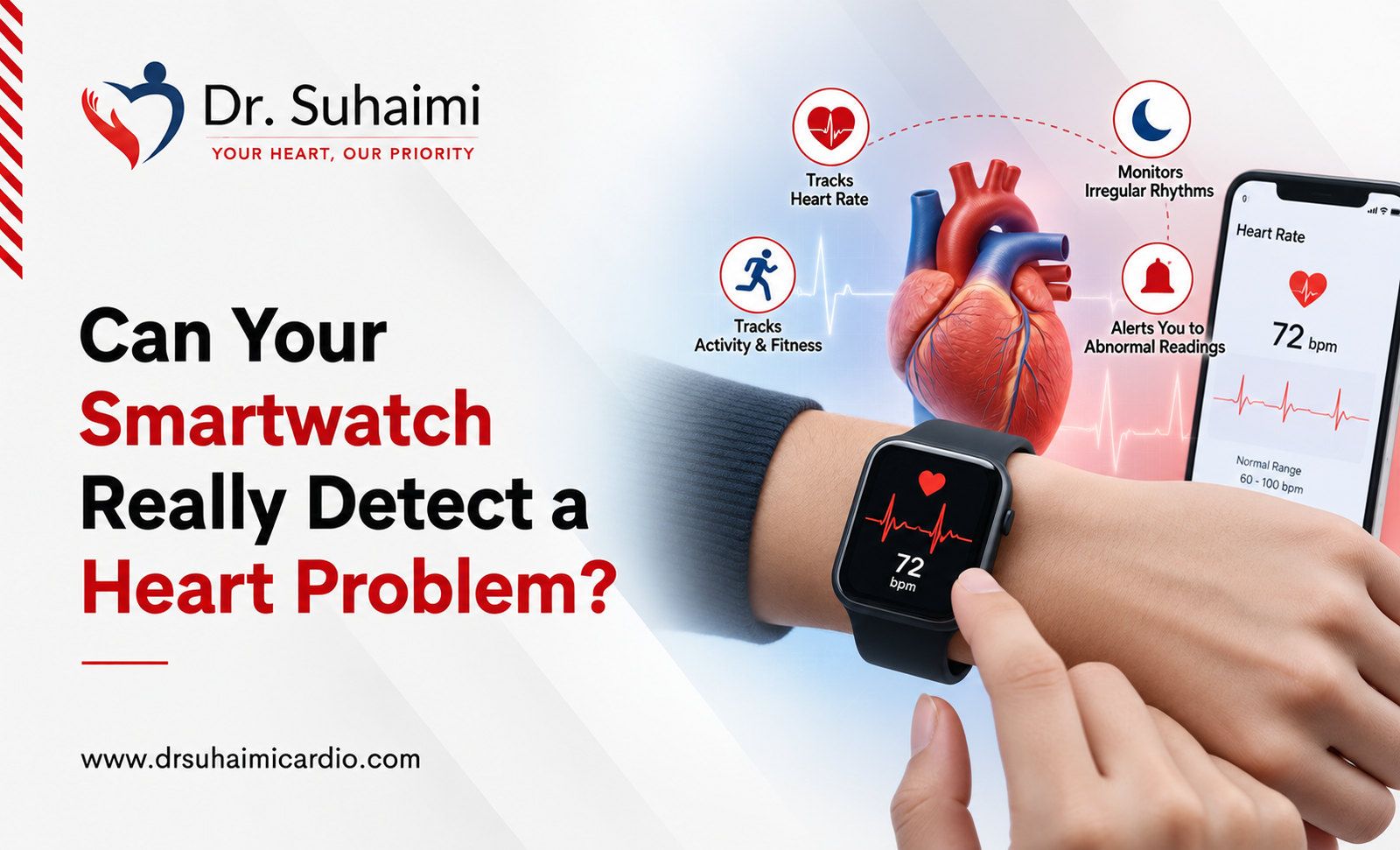
Can Your Smartwatch Really Detect a Heart Problem?
Smartwatches have become a part of everyday life — counting steps, tracking sleep, and now even monitoring heart rate and rhythm through built-in ECG features. This has led to a question many people are asking today: “Can my smartwatch actually detect a heart problem, or even a heart attack?”
It’s a fair question, and an important one, because when it comes to heart health, misplaced confidence in technology can be risky. In this blog, we’ll break down what a smartwatch can genuinely do, where its limits lie, and when it’s time to consult a real medical expert.
How Does a Smartwatch Track Heart Health?
Most modern smartwatches use optical heart rate sensors that shine light through the skin to measure blood flow. From this data, the watch calculates your resting heart rate, tracks variations during exercise, and in some cases, flags irregular rhythms.
Higher-end smartwatches also include a single-lead ECG (electrocardiogram) feature. This records the heart’s electrical activity and can pick up signs of atrial fibrillation (AFib), an irregular heart rhythm. While this technology is genuinely useful, it isn’t the same as a full medical-grade ECG performed in a hospital using a 12-lead machine.
What Can a Smartwatch Actually Detect?
When used correctly, a smartwatch can reasonably pick up on a few things:
- Abnormal heart rate – unusually fast or unusually slow heartbeats
- Irregular rhythm patterns – which may indicate early signs of AFib
- Unusual spikes during activity – possible signs of exercise-induced cardiac stress
- Long-term trends – such as gradual changes in resting heart rate over time
These data points can be genuinely helpful for staying aware of your body and catching potential issues early.
What Is the Biggest Limitation of a Smartwatch?
Here’s the most important thing to understand — a smartwatch doesn’t diagnose, it only alerts. It’s a screening tool, not a medical device. Other classic heart attack symptoms, such as chest pain, discomfort in the jaw or arm, sweating, or shortness of breath, are things a smartwatch simply cannot detect.
Even more critical: if someone is actually having a heart attack, relying on a wearable device and waiting at home can be dangerous. In such an emergency, reaching a qualified medical facility immediately is the right move, because timely Heart Attack Treatment is what actually saves a patient’s life — a smartwatch notification is never a substitute for emergency medical care.
When Should You Take a Smartwatch Alert Seriously?
If your smartwatch repeatedly shows irregular heart rhythm, an unusually high resting heart rate, or an AFib-type alert, don’t ignore it. This is a sign that you need a professional evaluation — even if you feel no symptoms at all, since heart conditions can often develop silently.
In such cases, the best approach is to consult a qualified Heart Specialist in Klang Valley without delay. An expert cardiologist can run proper diagnostic tests — such as an ECG, echocardiogram, or stress test — to confirm whether the smartwatch alert reflects a real concern or a false alarm.
The Right Balance Between Technology and Expert Care
The biggest advantage of a smartwatch is that it makes you more proactive about your health. But the final diagnosis and treatment plan should always come from a trained cardiologist, who considers your complete medical history, test results, and clinical examination before making a decision.
That’s why, if your smartwatch data shows any consistent irregularity, the wise step is to consult an experienced Interventional Cardiologist rather than relying on self-diagnosis. In Malaysia, specialists like Dr. Suhaimi Bin Osman, with 17+ years of clinical experience, guide patients through every stage — from accurate diagnosis to angioplasty, stenting, pacemaker implants, and long-term preventive cardiology care.
Quick Answers (FAQs)
Q1. Can a smartwatch predict a heart attack?
No. A smartwatch can detect abnormal heart rate or irregular rhythm, but it cannot directly predict a heart attack. If you experience symptoms, seek medical help immediately.
Q2. How accurate is a smartwatch’s ECG feature?
It’s a single-lead ECG that can pick up basic signs of conditions like AFib, but it isn’t as detailed or accurate as a hospital’s 12-lead ECG.
Q3. What should I do if my smartwatch shows an irregular heart rhythm?
Don’t ignore the alert. See a cardiologist as soon as possible for proper diagnostic testing.
Q4. Can everyone rely on a smartwatch alone to manage their heart health?
No. A smartwatch is a helpful monitoring tool, but it’s not a replacement for professional medical evaluation.
Conclusion
Smartwatch technology certainly helps raise awareness about heart health, but it cannot replace a doctor. It’s an early-warning tool at best — the final word always belongs to a qualified cardiologist. If your watch ever shows an unusual pattern, don’t wait; seek expert consultation in time, because when it comes to heart health, caution is always the best protection.